Inferred targeting built the last era of digital advertising. AI assistants may make a different signal more valuable: the commercial intent a user knowingly approves.
Inferred behaviour is powerful, but imperfect.
Digital advertising has spent decades improving its ability to infer intent from behaviour. Clicks, browsing patterns, location, content engagement, purchase history and demographic models can all help predict relevance. But inference has limits. It can be noisy, stale, ambiguous and hard for users to understand.
In AI assistants, the context changes. Users often arrive with immediate intent: they are comparing options, looking for recommendations, planning a purchase, booking a service, researching alternatives or asking for help making a decision. That creates a high-value commercial moment — but the platform must handle it without compromising user trust.
User-approved intent can be cleaner than hidden inference.
The strongest commercial signal may not be what the platform can infer from a user’s past. It may be what the user is willing to approve in the moment. A user may choose to share that they are researching electric cars, comparing insurance, looking for sustainable travel, seeking local services or open to offers in a particular category.
That signal is commercially valuable because it is current, contextual and permissioned. It can help advertisers respond to genuine relevance while reducing dependence on opaque tracking or broad audience assumptions.
Why this matters to AI platforms.
AI platforms need to monetise discovery without turning the assistant into an undisclosed sales channel. Yamu’s patent-backed relevance here is that the user-approved signal is not treated as a flat commodity: the commercial value can be informed by engagement, feedback and propensity to respond, allowing a higher-quality signal layer than broad inferred targeting. A user-approved signal layer creates a principled route: the user controls the permission boundary, advertisers compete for relevant intent, and the platform can preserve answer independence.
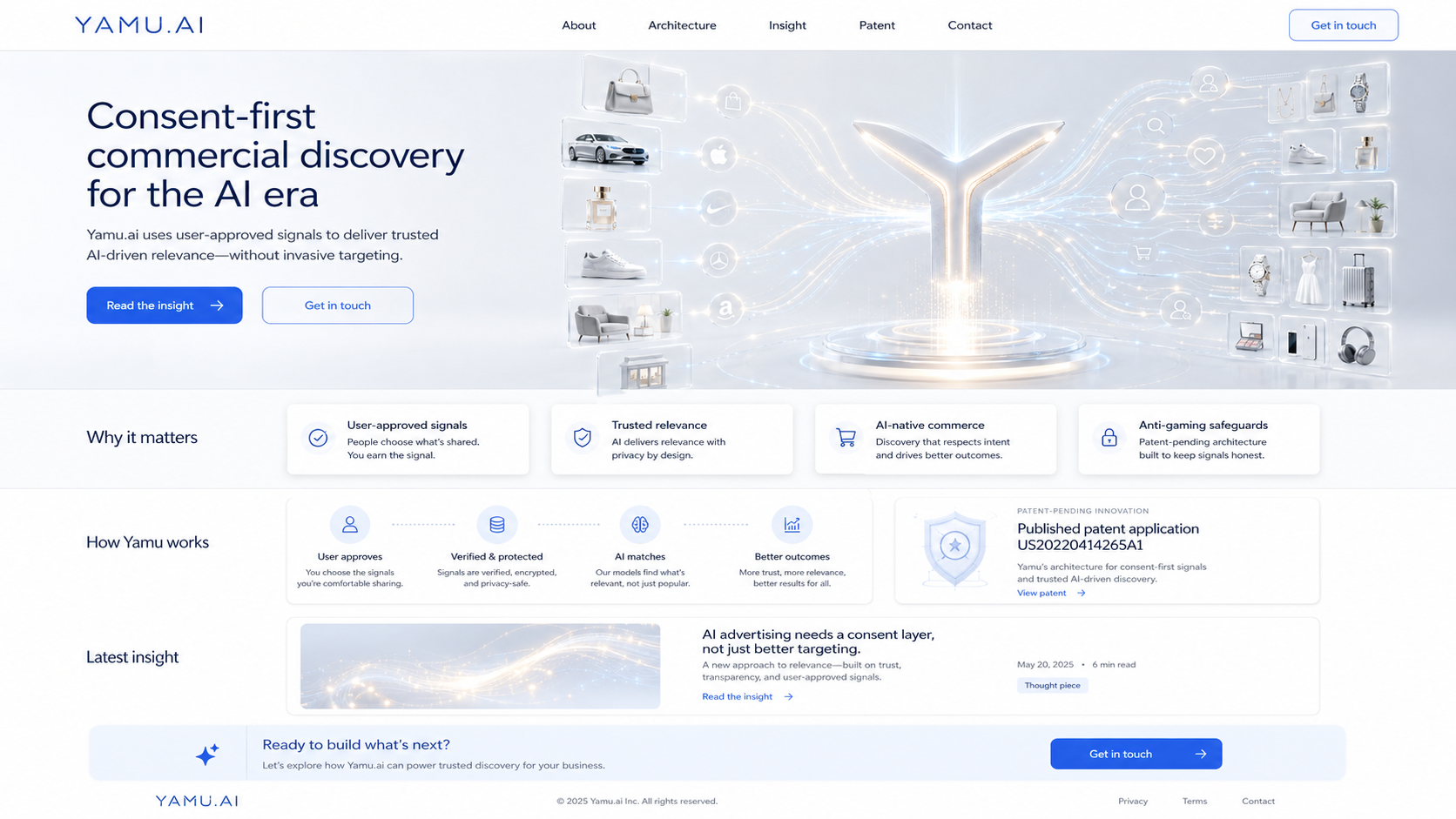
Yamu’s published patent application, US20220414265A1, is strategically important because it anticipates a consent-based search and commercial discovery model built around user-approved information, vendor matching, compensation mechanics and anti-gaming safeguards.