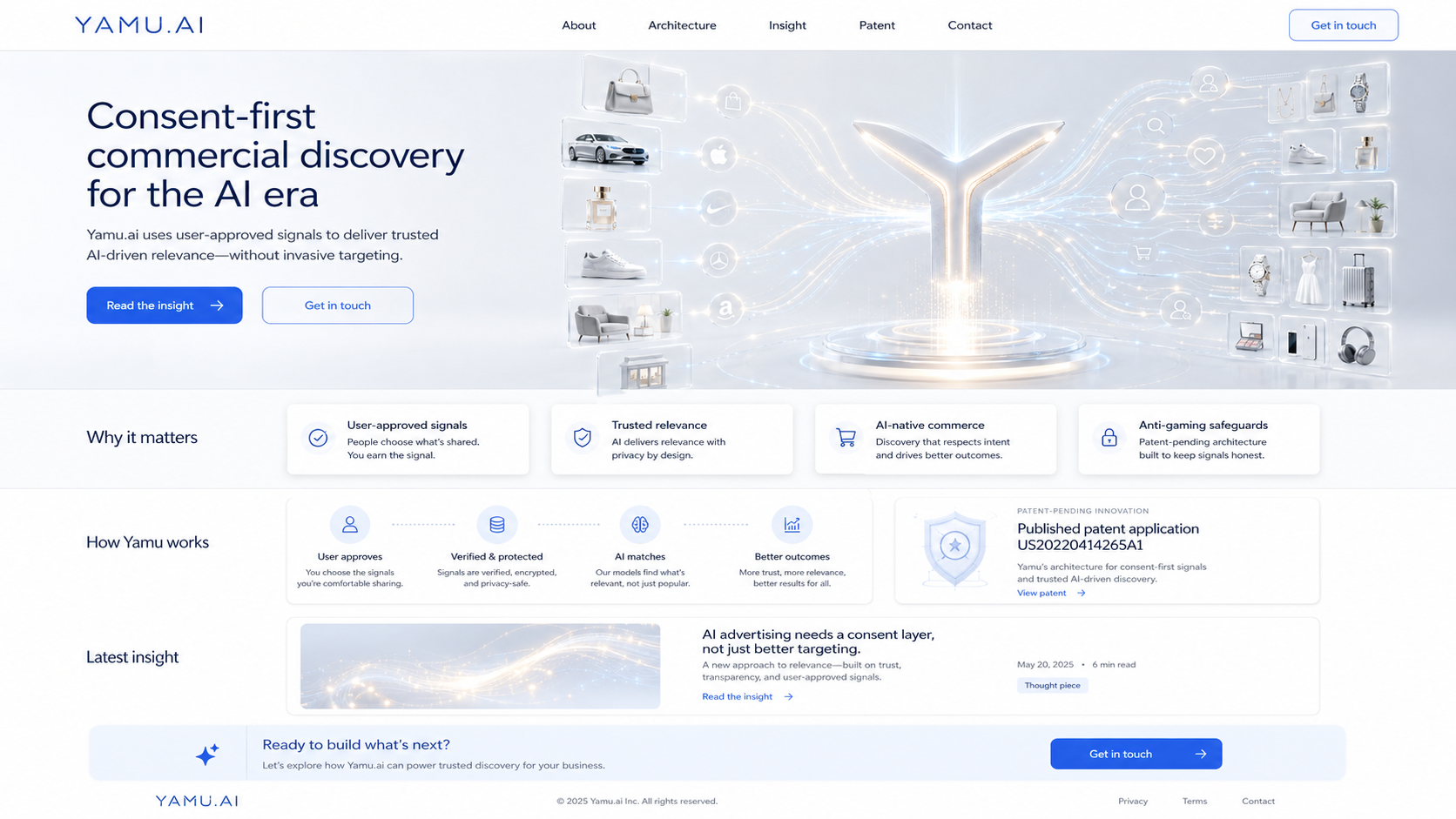
The strategic importance of Yamu is not limited to one product category. Its patent-backed concepts sit beneath several emerging commercial systems: AI advertising, search, browser discovery, commerce, user data control and agent-mediated recommendations.
The core partner question
How can digital platforms create commercial relevance without relying only on opaque inference, exposed identity or low-quality advertising signals?
Yamu’s answer begins with permissioned commercial intent: the user approves the signal, the platform brokers relevance, advertisers or vendors respond when requirements are met, and commercial value is protected through engagement, feedback and anti-gaming safeguards.
For AI platforms
Yamu provides a framework for thinking about trusted monetisation: how commercial discovery can be supported without exposing private user context or weakening confidence in the underlying assistant experience.
For advertisers and agencies
Yamu points toward a higher-quality signal model. Instead of relying only on inferred interest, advertisers may eventually respond to approved commercial intent, feedback loops and propensity-weighted signal quality.
For search, browser and commerce platforms
Yamu’s architecture can be understood as a new commercial layer alongside search, comparison, recommendation and shopping flows. It is particularly relevant where users are researching, comparing, waiting for offers, purchasing offline or still deciding.
For privacy, data and identity partners
The anonymised or blind-brokered relevance concept creates a route to richer commercial signals without unnecessary personal identity exposure. That makes the model relevant to privacy-preserving advertising, consent management, data clean rooms, identity infrastructure and trusted data exchange.
For agentic commerce
As user agents and merchant systems begin to mediate decisions, platforms will need rules for what can be shared, what remains private, how commercial relevance is established and how gaming is prevented. Yamu’s patent foundation is a starting point for that conversation.
Yamu’s role is to bring a patent-backed architecture into the conversation before the next generation of AI commercial discovery hardens around weaker models.